

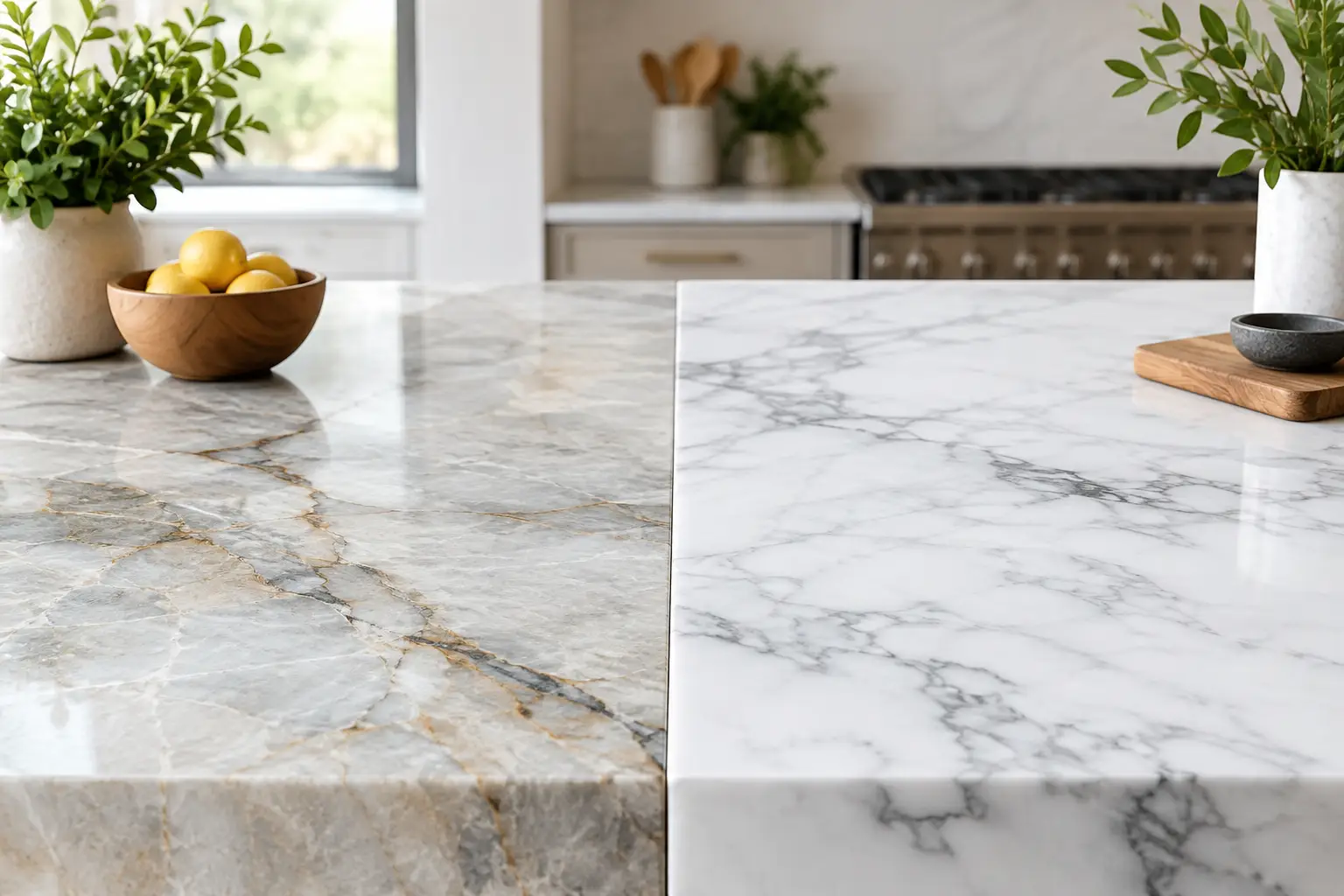
A countertop decision can change the entire character of a Manhattan kitchen. It affects how the room photographs, how it wears during busy mornings, and how confidently you use it when friends gather. When weighing quartzite vs marble countertops, the right answer is rarely about which stone is objectively better. It is about how your household lives, the look you want to protect, and the level of maintenance you are genuinely comfortable taking on.
Both materials belong in high-end homes. Both can make a kitchen feel tailored, substantial, and distinctly personal. But they perform differently under the daily pressures of cooking, entertaining, cleaning, and city living.
Quartzite vs Marble Countertops: The Core Difference
Marble is a metamorphic natural stone, valued for its soft movement, luminous depth, and classic veining. From a restrained honed slab to dramatic Calacatta, marble delivers a look that manufactured materials struggle to replicate. It is also relatively soft and chemically reactive, which means acidic foods and drinks can etch its surface.
Quartzite is also a natural stone, formed when sandstone is transformed under intense heat and pressure. It is typically much harder than marble and, when properly selected and sealed, is more resistant to scratching and etching. Its appearance can range from quietly neutral to highly expressive, with veining that may resemble marble while offering stronger day-to-day performance.
That distinction matters, but it should not reduce the decision to a simple durability contest. A countertop is a working surface and a major design element. For some homeowners, the graceful patina of marble is part of the appeal. For others, the confidence of quartzite is worth prioritizing, especially in an active family kitchen.
Choose Marble When Character Matters More Than Perfection
Marble has remained a luxury standard for good reason. It catches light beautifully and brings softness to a kitchen with crisp cabinetry, integrated appliances, or architectural millwork. In prewar apartments and refined downtown residences alike, it can make a new renovation feel established rather than overly new.
The trade-off is visible wear. Lemon juice, tomato sauce, vinegar, wine, and certain cleaners can leave dull marks known as etching. Etching is not the same as staining, but it can alter the finish. Marble may also scratch or chip more readily than quartzite, particularly at exposed edges and around heavily used areas.
A honed finish is often the practical choice for a kitchen because it makes small marks less conspicuous than a polished surface. It does not prevent etching, but it helps the stone age more gracefully. Homeowners who select marble successfully tend to make the decision with clear expectations: the countertop will develop a lived-in patina, and that is acceptable.
Marble can be especially well suited to a lower-impact kitchen, a baking-focused space, a butler's pantry, or a bathroom vanity. It is also an excellent choice when the slab itself is the design priority and the household is prepared to use coasters, wipe spills promptly, and avoid harsh cleaners.
Choose Quartzite for a More Forgiving Kitchen Surface
Quartzite is often the better fit for homeowners who want natural stone with fewer daily worries. Its hardness makes it more resistant to scratches than marble, and it generally holds up better around cooking zones, breakfast counters, and areas used by children or frequent guests.
It still requires care. Quartzite is porous to varying degrees and should be sealed according to the specific slab and fabricator's recommendation. A quality sealer helps reduce absorption, but it is not a license to leave spills unattended. Oils, dark sauces, and red wine should still be cleaned up promptly.
The visual benefit is substantial. Many quartzite slabs offer pale backgrounds and elegant veining that work beautifully with the light, composed kitchens Manhattan homeowners often request. Taj Mahal quartzite, for example, is prized for its warm, understated movement. Other varieties deliver bolder contrast and can anchor a kitchen with more dramatic cabinetry or metalwork.
One point deserves careful attention: stone names can be confusing in showrooms. Some materials marketed as "soft quartzite" may behave more like marble. Before a final selection, confirm the stone's composition, absorption characteristics, finish, and care requirements. A reputable renovation team and stone fabricator should help you evaluate the actual slab, not rely only on a label.
Durability Is About More Than Hardness
On paper, quartzite usually wins for scratch and etch resistance. In a real renovation, however, performance also depends on fabrication, installation, edge detailing, and how the stone is used.
A thin, unsupported overhang can create risk regardless of the material. A heavy waterfall edge requires precise templating and skilled handling. Seams need to be planned around slab movement, cabinet layout, and sightlines. In a Manhattan apartment, logistics matter too: slab delivery, elevator access, building protection, and coordination with cabinet installation must all be managed carefully to avoid delays or damage.
Marble and quartzite are both natural materials, so variation is part of the product. A sample will not capture every vein, mineral deposit, or shift in tone within a full slab. Viewing and approving the actual slab before fabrication is one of the most effective ways to protect the final design outcome.
Cost Depends on the Slab and the Scope
Neither marble nor quartzite belongs to a single price category. Material cost can vary dramatically based on rarity, origin, availability, slab yield, thickness, finish, and demand. A common marble may cost less than an exotic quartzite, while a premium marble can exceed many quartzite options.
The material is only one part of the investment. Fabrication, cutouts, edge profiles, full-height backsplashes, bookmatching, waterfall panels, reinforcement, delivery, and installation can significantly affect the final number. In New York City, building requirements and site logistics may add another layer of planning.
The most useful comparison is not a broad per-square-foot estimate. It is an itemized scope built around the specific slabs, kitchen layout, and details you want. That approach prevents a beautiful initial selection from becoming a surprise later in the project.
How Finish and Design Affect the Decision
A countertop does not exist on its own. Cabinet color, lighting temperature, hardware, floor tone, and backsplash selection will all influence how the stone reads once installed.
Marble often works best when the goal is softness and traditional luxury. A honed white marble paired with warm white cabinetry, unlacquered brass, and a restrained backsplash can feel calm and enduring. For a more contemporary home, marble with pronounced veining can become the kitchen's central visual statement.
Quartzite is highly versatile. A neutral quartzite can provide an elevated foundation without competing with detailed cabinetry, while a more active slab can create the same focal-point effect as dramatic marble. It is particularly compelling for open kitchens where the island serves as both a work surface and a major piece of furniture.
Consider the backsplash early. Running the same slab up the wall creates a cohesive, high-impact composition, but it increases material needs and requires thoughtful seam placement. If the stone has strong movement, layout planning becomes even more important. The difference between a well-bookmatched wall and a poorly planned one is immediately visible.
Care Expectations Before You Commit
If you want a countertop that will stay visually uniform with minimal attention, neither natural stone will behave like an engineered surface. Natural stone rewards homeowners who understand its characteristics and accept a degree of variation over time.
For marble, expect etching and occasional surface marks. Use a pH-neutral stone cleaner, avoid abrasive pads, and treat the finish as part of the material's evolving character. For quartzite, maintain the sealer, clean spills in a timely manner, and use cutting boards even though the stone is hard. Cutting directly on any countertop can dull knives and introduce unnecessary risk at seams or edges.
For many busy households, quartzite provides the better balance of luxury appearance and practical resilience. For homeowners drawn to the unmistakable depth of marble, no substitute will fully replace it. The best decision is the one you can enjoy without constantly policing how your kitchen is used.
A well-managed renovation should make room for that decision before cabinets are ordered and fabrication is scheduled. Reviewing full slabs, confirming care requirements, coordinating details, and pricing the complete installation upfront gives you the confidence to choose a surface for how you want to live, not just how you want the kitchen to look on day one.