

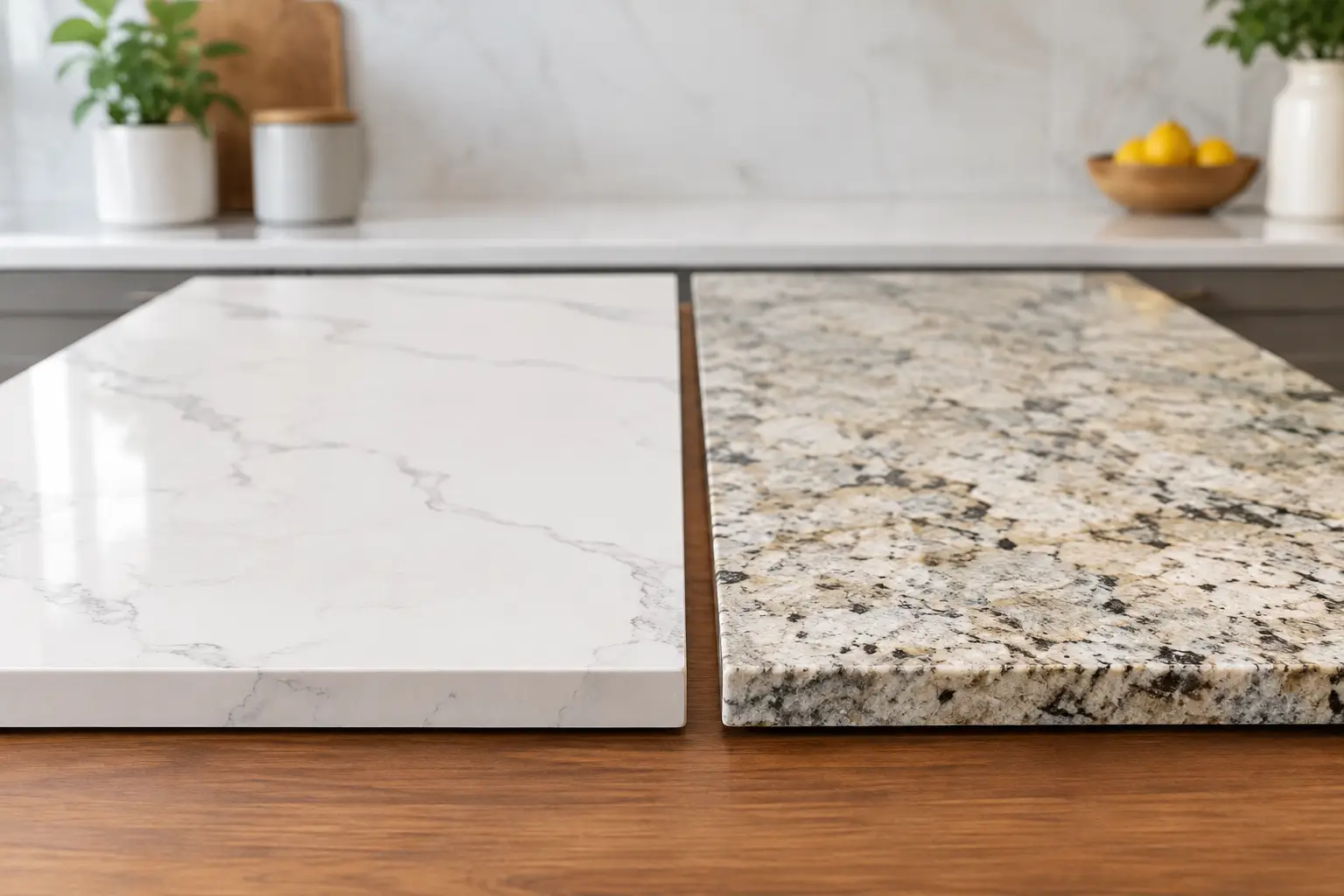
A countertop choice can define the entire kitchen - not just visually, but in how confidently you use the space every day. When weighing quartz versus natural stone countertops, Manhattan homeowners are usually balancing three priorities: a refined look, realistic maintenance, and long-term value within a tightly managed renovation.
There is no universal winner. A polished Calacatta marble island can bring unmistakable character to a prewar apartment, while engineered quartz may be the better fit for a busy family kitchen where spills, homework, and weeknight cooking all happen at once. The right material depends on the home, the cabinetry, the way you live, and the level of care you are prepared to give it.
Quartz Versus Natural Stone Countertops: The Core Difference
Quartz countertops are engineered surfaces. They are made primarily from crushed natural quartz combined with resins, pigments, and binders, then manufactured into consistent slabs. This construction gives quartz its broad color range, dependable patterning, and nonporous surface.
Natural stone is quarried directly from the earth, cut into slabs, and finished for residential use. Marble, granite, quartzite, soapstone, and limestone each have distinct mineral compositions, movement, porosity, and performance characteristics. No two natural stone slabs are exactly alike, which is a major part of their appeal.
For a luxury renovation, the distinction is not simply natural versus manufactured. It is about whether you want controlled consistency or one-of-a-kind variation. Quartz delivers predictability. Natural stone delivers depth, individuality, and a material story that cannot be duplicated in a factory.
Daily Performance: Stains, Heat, Scratches, and Care
For many apartment owners, maintenance is the deciding factor. Quartz is nonporous, so it does not require sealing under normal conditions. It resists common kitchen stains from coffee, wine, oil, and acidic foods better than many natural stones. Routine care is straightforward: a soft cloth, mild soap, and prompt cleanup are generally enough.
Quartz does have limits. It is not the best surface for direct, extreme heat. A hot pan placed directly on quartz can damage the resin or leave a mark, so trivets remain essential. Strong chemical cleaners, abrasive pads, and prolonged sun exposure can also create problems, particularly near large windows or on sun-filled terraces.
Natural stone requires more informed care, but its performance varies widely by type. Granite is generally durable and heat resistant. Quartzite is exceptionally hard and often performs well in hardworking kitchens, though it still needs periodic sealing. Marble is softer and more reactive to acid, making it more likely to etch when exposed to lemon juice, vinegar, or wine. Soapstone is forgiving with heat but can scratch and develop a naturally aged patina.
That patina is either a benefit or a concern. Some homeowners see the subtle marks on marble as part of a lived-in, European kitchen. Others want every surface to look pristine for years. Neither preference is wrong, but it should be settled before the slab is selected, not after the kitchen is in use.
Design Impact: Consistency or Authentic Movement
Quartz has advanced considerably in recent years. Premium collections can recreate the veining associated with marble, the warmth of limestone, or the graphic movement of dramatic natural slabs. It works particularly well when a homeowner wants a clean, quiet backdrop, bookmatched-looking continuity, or a precise color relationship with painted cabinetry.
Because quartz is manufactured, it offers more control over color and pattern. This can simplify the design process in a Manhattan renovation, especially when cabinetry, backsplash tile, flooring, and lighting must all be finalized on a defined schedule. You can approve a sample with greater confidence that the installed material will align with the overall design direction.
Natural stone has a visual complexity that engineered materials can imitate but not fully reproduce. Its veining has depth. Its colors shift under daylight and evening lighting. A dramatic quartzite, richly veined marble, or honed granite can become the focal point that makes a kitchen feel truly custom.
The trade-off is variation. A small sample will not tell the whole story of a natural slab. Before fabrication, homeowners should view and approve the actual slab, particularly when the material has bold movement or when seam placement, waterfall edges, and backsplash returns are part of the design. Proper slab layout is craftsmanship, not an afterthought.
Cost Is More Than the Price Per Square Foot
Countertop budgets are often discussed as a material cost, but the installed number is shaped by much more. Slab yield, thickness, edge detail, cutouts, fabrication complexity, delivery access, and installation requirements all affect the final investment.
Quartz can be cost-effective in standard applications, but premium designs and oversized island slabs can move it into a luxury price range. Natural stone spans an even wider range. Some granites are relatively accessible, while rare marble and high-demand quartzite can command substantially higher costs because of slab selection, sourcing, waste, and fabrication demands.
In New York City, logistics matter as much as the material itself. A large slab may need careful delivery coordination, elevator protection, building insurance documentation, and a planned route through narrow hallways or service entrances. A fully itemized estimate should account for these realities upfront, rather than treating them as surprises after a slab has been purchased.
It is also worth considering replacement risk. If a natural stone slab is damaged before or during installation, finding an exact match may be difficult or impossible. With quartz, replacement and continuity are typically more manageable. This does not mean quartz is automatically the safer financial choice, but it is a practical consideration when timing and budget control are priorities.
Which Surface Fits Your Household?
Quartz is often the right choice for homeowners who want a polished, low-maintenance kitchen with consistent color and strong stain resistance. It is especially practical for households with young children, frequent entertaining, or limited time for specialized surface care. In a rental investment or secondary residence, quartz can also offer a dependable, broadly appealing finish.
Natural stone is often the right choice when material authenticity is central to the design. A cook who values heat resistance may prefer granite or quartzite. A homeowner renovating a classic Upper East Side apartment may choose marble because its elegance feels appropriate to the architecture. For a downtown loft, a leathered granite or soapstone surface can add warmth and texture that balances contemporary millwork.
The best decision is often more specific than quartz versus stone. A kitchen might pair durable quartz perimeter counters with a natural stone island, where the visual impact is greatest and the surface can be treated with more care. A marble backsplash may deliver the desired luxury while a quartz work surface handles daily preparation. Thoughtful combinations can protect both the design vision and the way the room functions.
Details That Protect the Finished Result
Countertop performance depends heavily on planning and installation. Cabinets must be level and properly secured before templating. Overhangs need the correct support. Sink cutouts, faucet placement, seam locations, outlet coordination, and backsplash thickness should all be resolved before fabrication begins.
This is particularly important in older Manhattan residences, where walls, floors, and existing conditions are not always perfectly square or level. A professional field measure after cabinetry installation helps prevent fit issues and avoids forcing a finished slab to compensate for unresolved construction conditions.
Home Design & Co approaches countertop selection as part of the full renovation system, not as an isolated finish decision. Design, material selection, fabrication coordination, building logistics, and installation sequencing should work together so the surface looks as considered in person as it did in the original plan.
A beautiful countertop should support your life, not create another rulebook for living in your own kitchen. Choose the surface whose character, care requirements, and installation plan give you confidence every time you set down a glass, prepare a meal, or welcome guests around the island.