

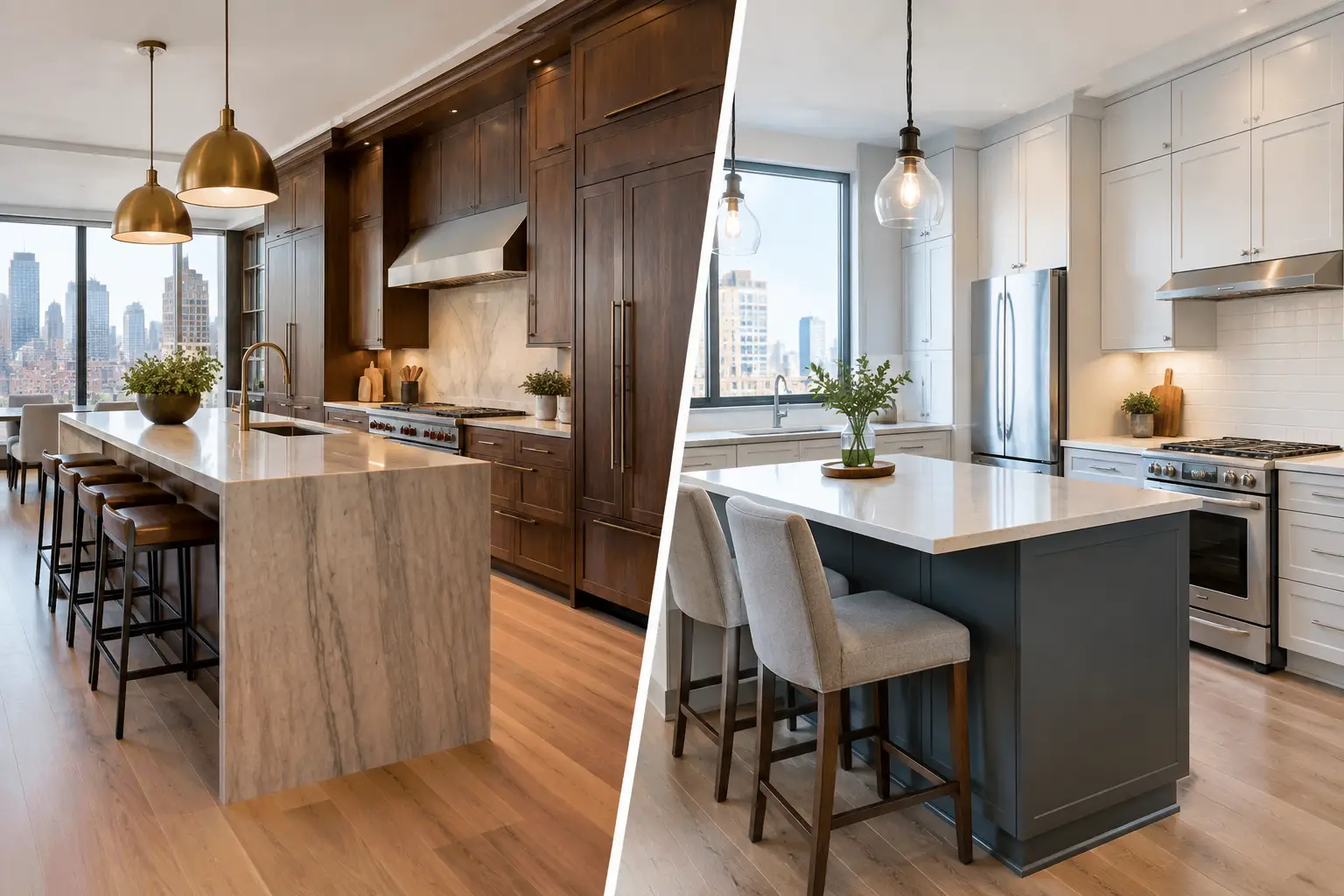
A Manhattan kitchen rarely offers the luxury of forgiving dimensions. A soffit that drops unexpectedly, a structural column near the range, or a wall that is slightly out of square can affect every cabinet decision. That is why the custom cabinets vs semi custom conversation is not simply about appearance or price. It is about how precisely your kitchen must perform, how much design freedom the space requires, and how confidently the work can be executed within your building’s rules.
For a high-end kitchen renovation, both options can produce a refined result. The right choice depends on the conditions of your home, the level of detail you expect, and where you want to invest your budget.
What separates custom cabinets from semi-custom?
Custom cabinetry is designed and built specifically for your kitchen. Each cabinet box, door, drawer, finish, and interior detail can be tailored to the room and the way your household lives. Widths, heights, depths, and storage components are not limited to a preset catalog of standard sizes.
Semi-custom cabinetry begins with an established cabinet line and expands on it. You typically select from a wide range of door profiles, finishes, hardware options, organizational inserts, and cabinet sizes. Many semi-custom manufacturers also offer modifications, such as reduced-depth cabinets or altered widths, within defined limits.
The distinction matters most when a kitchen has difficult geometry or when the design relies on details that must align perfectly. In a straightforward rectangular kitchen, a well-planned semi-custom line may meet the design brief beautifully. In a prewar Manhattan apartment with uneven walls, radiator pipes, unusual ceiling heights, and limited clearance around doorways, custom cabinetry can solve problems that standard sizing cannot.
Custom cabinets vs semi custom: the fit question
Fit is often the deciding factor in New York City homes. Every unused inch can feel significant when storage is limited and circulation is tight. Custom cabinetry allows a design team to build to exact measurements, which can reduce filler panels, maximize vertical storage, and create a more architectural appearance.
For example, a custom cabinetmaker can create a narrow pullout beside a range, extend uppers precisely to a ceiling molding, or design a pantry around a building riser. Custom work can also accommodate a deeper countertop at one workstation, a concealed appliance garage, or cabinetry that wraps an awkward corner without wasting usable volume.
Semi-custom cabinets can still provide an excellent fit when the room has relatively standard wall runs and the design accepts some fillers or trim pieces. The best semi-custom plans do not look compromised. They use careful layout, appropriately sized panels, and thoughtful appliance coordination so that the finished kitchen feels intentional rather than assembled around limitations.
The key is honest field verification before orders are finalized. In NYC, measurements taken before demolition may not reveal every condition behind existing walls. A managed renovation process accounts for those unknowns, confirms dimensions at the right stage, and protects the cabinet plan from costly last-minute changes.
Design freedom and finish quality
Custom cabinetry offers the broadest creative control. It is the stronger choice when you want a distinctive wood species, a proprietary paint color, a nonstandard door profile, integrated metalwork, or a cabinet layout that is unique to the residence. It also makes sense for kitchens designed as part of a larger architectural composition, especially where millwork continues into a dining area, library, mudroom, or living space.
That flexibility has practical value, not just visual appeal. Custom interiors can be designed around specific cookware, serving pieces, small appliances, and accessibility needs. A serious home cook may want a knife drawer with dedicated inserts, deep drawers sized for Dutch ovens, or a pullout system configured around a preferred coffee setup. A family may prioritize concealed snack storage, charging drawers, and easy-to-reach everyday dishes.
Semi-custom manufacturers have made major progress in finish selection and storage accessories. Many offer high-quality painted finishes, wood veneers, inset-style doors, pullouts, spice storage, waste systems, and panel-ready appliance solutions. For homeowners who prefer a classic shaker kitchen, a clean slab-front kitchen, or another established style, semi-custom may provide the look they want without designing every component from the ground up.
However, selections should be reviewed in person whenever possible. Door samples, finish samples, and construction details tell a more accurate story than a screen image. Look at the consistency of the finish, the feel of the drawer hardware, the thickness of panels, and how the cabinetry will meet surrounding materials such as stone, plaster, flooring, and decorative lighting.
Cost: where the difference really comes from
Custom cabinets generally cost more because they require greater design time, engineering, material flexibility, and skilled shop labor. The price reflects more than the cabinet boxes. It includes the process needed to create work that fits a specific home precisely and meets a detailed design standard.
Semi-custom cabinetry is usually the more predictable path for a homeowner working within a defined investment range. Because the manufacturer already has an established production system, many choices can be priced and ordered more efficiently. That can leave room in the renovation budget for premium appliances, a more substantial stone selection, specialty lighting, or upgraded plumbing fixtures.
Still, cabinet pricing should never be evaluated in isolation. A lower cabinet quote can become less attractive if it creates expensive site modifications, leaves awkward gaps, or requires design compromises that you will notice every day. Conversely, custom cabinetry may not be the best use of funds if a semi-custom line delivers the desired fit, finish, and storage performance.
A detailed estimate should clarify what is included: cabinet supply, design, delivery, installation, panels, trim, hardware, internal accessories, appliance panels, touch-up work, and any field modifications. This level of transparency matters in a luxury renovation, where incomplete allowances can make an early budget appear more favorable than the final cost.
Lead times and project coordination
Neither option should be treated as a quick decision. Semi-custom lines often have shorter or more predictable lead times than fully custom work, but availability varies by manufacturer, finish, modification level, and current production demand. Custom cabinetry may require more time for shop drawings, approvals, fabrication, finishing, and installation.
The better question is whether the cabinetry schedule is coordinated with the full construction plan. Cabinets affect demolition timing, electrical locations, plumbing rough-ins, appliance specifications, countertop templating, backsplash installation, and final inspections. In a co-op or condo, delivery windows, elevator reservations, certificates of insurance, and building protection requirements must also be planned well in advance.
A white-glove renovation team manages these dependencies before they become disruptions. At Home Design & Co, cabinet decisions are considered alongside the complete design and construction scope, helping clients avoid a beautiful cabinet plan that conflicts with site conditions, building logistics, or the installation sequence.
When semi-custom is the smart luxury choice
Semi-custom is often the right answer for a homeowner who wants premium materials and a polished design without requiring fully bespoke construction. It can be especially effective in newer condominiums, well-proportioned apartments, and kitchens where standard cabinet dimensions align naturally with the layout.
It is also a sensible choice when the project requires a dependable schedule and the homeowner would rather direct additional budget toward visible finishes or performance upgrades. A semi-custom kitchen can feel tailored when proportions are carefully planned, appliance panels are properly detailed, and the installation is handled with precision.
The mistake is assuming semi-custom means ordinary. The quality of the design, installation, lighting plan, hardware selection, countertop fabrication, and finishing details will shape the result just as much as the cabinet category.
When custom cabinetry earns its investment
Custom is worth considering when the kitchen presents complex constraints or when no available cabinet line can achieve the design intent. It is particularly compelling in landmarked or prewar residences, unusually narrow galley kitchens, rooms with irregular walls, and homes where cabinetry must integrate with extensive custom millwork.
It also becomes the better long-term value when storage needs are highly specific. If custom solutions eliminate daily frustrations, improve organization, and make a compact kitchen function like a larger one, the investment is felt long after construction is complete.
Before making the choice, ask to see the cabinet layout at a true scale, including fillers, panels, clearances, appliance openings, and door swings. Understand which details are fixed by the manufacturer and which can be adjusted. The right cabinetry should not only look exceptional in a rendering. It should fit the room, support your routines, and arrive as part of a plan that is ready to be built properly.